

3D Printing for High Volume Production
作者:Shenzhen Seetop Technology Co.,Limited
浏览:
发表时间:2020-01-13 14:52:00
3D Printing for High Volume Production
Additive manufacturing or “3D printing” has come a long way since originally introduced in the 1980’s as a method to conveniently create prototype parts out of plastic.. Additive manufacturing can now be used with various materials including metal and ceramics, giving injection molders an alternative process for building parts. With new, highly sophisticated 3d printers for metal printing, the ability to print metal, three-dimensional parts from a computer aided design (CAD) file has become cost effective for both prototyping and some production environments. While startup costs can be high, the convenience of additive manufacturing with the added potential of volume production is forcing traditional fabrication shops to change their mindset about the role of 3d printing, and the technology is being embraced by major manufacturers like GE, Honeywell, IBM and others.
The move to mass production
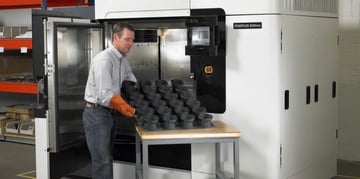
Over recent years, 3D printing’s technology proposition has expanded considerably from its ‘heritage’ in rapid prototyping for the automotive design studio to producing serial production parts for the production assembly line. Creating highly-tailored tools to increase efficiency on the factory floor is one of the most significant emerging applications of 3D printing in automotive today. As such, Stratasys systems are now a common fixture on factory floors throughout the automotive supply chain.
For example, Opel in Germany has used Stratasys 3D printing for factory floor tools, transforming the in-house production line through more efficient, quicker workflows. Another example is Volvo Trucks in France, which has employed Stratasys’ Fortus 3D Printing Technology to design different durable yet lightweight clamps, jigs, supports and tool holders for the production line at their Lyon-based facility. Replacing metal tools and 3D printing custom tools for direct use on the factory floor, Volvo Trucks estimates that for small quantities of tools, the cost of 3D printing ABS thermoplastic items can be as little as 1€/cm3. Making the same item from metal has resulted in costs of 100€/cm3. Crucially, Volvo Trucks has reduced the time taken to design and manufacture certain tools traditionally produced in metal, from 36 days to just two days in thermoplastic ABSplus – a decrease of more than 94%. Similarly, across the pond in the USA, Ford is also using our FDM-based technology for the manufacture of production-line tools and individual parts.
High-volume production, as seen in automotive assembly lines, is exceptionally sensitive to cycle time efficiency. If the same operation is performed on an assembly line thousands of times a year, shaving a few seconds from the process saves hundreds of thousands, or even millions, of dollars. New technology and material developments from Stratasys and other additive manufacturing companies push the boundaries of what is possible. Tough, durable FDM thermoplastics that withstand rugged manufacturing environments enable auto manufacturers to create custom tools on demand, revise jigs, fixtures and tooling on the fly to improve designs or reduce weight.
Additionally, additive manufacturing can improve working environments and processes for production line operators, which presents a whole new value-add beyond the more obvious and easy-to-quantify advantages associated with the time and cost efficiencies enjoyed from producing the tools. In this case, the opportunity to 3D print tools that are customized to individual operators offers the potential to minimize RSI-related injuries that could invariably impact manufacturing workflow.
Although 3D printing exists in production circles outside of hobbyist activity, it's not exactly clear whether or not it can be effective in mass production. Here's a more detailed look into the capabilities of 3D printing for mass production.
3D PRINTING MASS PRODUCTION
In the following paragraphs, we’ll present some successful applications of 3D printing to mass production. Let’s dive in!
3D PRINTING MASS PRODUCTION
Adidas: Shoe Midsoles
As mentioned above, Adidas is utilizing 3D printing mass production in a rather unique way. Back in 2017, the company revealed its collaboration with Carbon to produce midsoles for their new sneaker, the Futurecraft 4D.
The midsole for the Futurecraft 4D features an incredibly complex geometry, which would be extremely challenging if not impossible to produce using standard manufacturing techniques. That’s why Adidas went down the 3D printing route.
In 2018, Adidas set the goal to produce 100,000 pairs of shoes (meaning 200,000 midsoles) by the end of the year. While it may seem like a lofty goal, Carbon was able to reach it with soles to spare!
But how on Earth did they manage to produce so much in such a short period? Well, that’s thanks to Carbon’s Digital Light Synthesis technology, which enables fast production of high-quality parts.
The technology basically works like digital light processing (DLP). What makes Carbon’s technology stand out is the extremely precise prints. This precision is possible due to Carbon’s use of a high-performance LED light engine, which projects images of the part’s cross-sectional areas. That causes the resin to cure in the desired shape. No different than DLP technology.
Thanks to Carbon’s innovative approach to 3D printing, it’s possible to create complex end-use parts, like the midsoles of the Adidas Futurecraft 4D.
3D PRINTING MASS PRODUCTION
BMW: End Use Parts
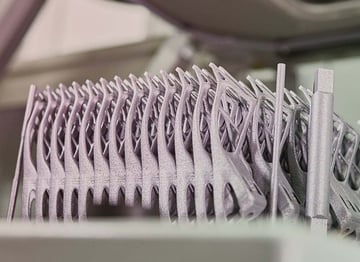
3D printing technologies have been implemented by automakers for quite some time now, mostly for rapid prototyping. As 3D printing technologies such as SLM (Selective Laser Melting) became more advanced and more affordable, 3D printing metal end-use parts was made possible.
One of the best examples for such a case is BMW. Since 1990, BMW has been researching 3D printing technologies. And now, 3D printing is entering their production lines with their latest flagship model: the BMW i8 Roadster.
BMW is using SLM 3D printers to produce the mountings for the top cover of the roof opening/closing mechanism. As BMW stated, it would not have been possible to produce such part using a traditional casting process. Also, BMW claims the 3D printed part is stronger and lighter weight.
Considering it’s a flagship model, the BMW i8 Roadster will be produced in rather big quantities. Although we don’t know the exact number, we know for a fact that the i8 Roadster is, in fact, a mass-produced vehicle, like most other BMW’s.
This proves 3D printing is able to handle mass part production. Because the parts are made out of metal powder, using a powder sintering technology, it’s possible to 3D print a whole lot at once.
Take a look at the picture above, and you’ll see how many BMW can produce at a single machine at once!
3D PRINTING MASS PRODUCTION
Chanel: Mascara Brush
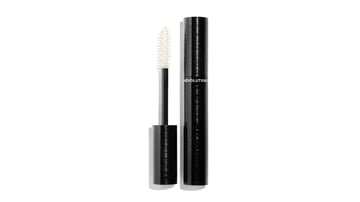
Believe it or not, nowadays even mascara brushes are getting 3D printed! Chanel is heading this movement by partnering with Erpro Group, a 3D printing company based in Paris.
Chanel’s goal is to 3D print around a million of these brushes per month. That’s some serious 3D printing mass production!
The idea behind 3D printing a mascara brush is to enhance its performance. Unfortunately, we don’t know which 3D printing technology was used in the production of these brushes.
But what sets these brushes apart from the standard ones? Well, it’s the design. Chanel designed these new brushes so that a higher volume of mascara could be applied to the brush. Also, new 3D printed brushes should provide better adhesion of the mascara to the eyelashes.
3D PRINTING MASS PRODUCTION
Rehook: Mid-Level Production
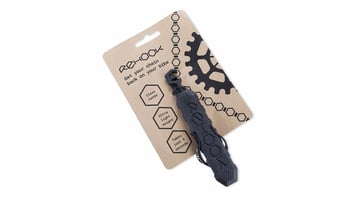
Rehook is a handy tool which helps you get your dropped bike chain back on track. It was developed by a group of cyclists and is currently being produced on SLS 3D printers using graphite-filled nylon material.
Rehook is produced in mid-level production volumes entirely using 3D printers. Although this article is about 3D printing in mass production, we still felt the need to include Rehook.
This is a great example of how 3D printing can make production faster and cheaper. After all, Rehook is a startup, which means every dollar is hugely important.
3D printing enabled Rehook to place the product on the market in a short period of time. If there wasn’t 3D printing, Rehook would first need to invest traditional techniques making the production more expensive.
Since SLS is utilized for production, it enables a large amount of Rehooks to be produced at the same time and with great quality.
3D PRINTING MASS PRODUCTION
IKEA: Hand-Shaped Hooks
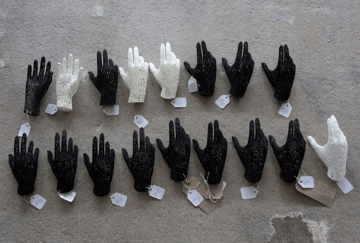
Swedish furniture giant IKEA decided to select 3D printing as a manufacturing solution for one of its newest products: a mesh hand from the OMEDELBAR collection.
IKEA’s OMEDELBAR collection was created in a collaboration with stylist Bea Åkerlund. IKEA’s first ever 3D printed mass-produced product is a mesh hand from the OMEDELBAR collection.
The mesh hand can be hung on the wall or used as a decorative hanger for jewelry. The production quantity is unknown, but we know for a fact it’s big enough to be considered as mass production.
The 3D printing technology of choice for IKEA is SLS, which enables the production of multiple OMEDELNAR mesh hands at once on a single machine.
But, at the end of the day, why did IKEA go down the 3D printing route? Well, it was surely done in order to make a step forward in innovation, but there’s also a practical reason.
As stated by an IKEA employee, sometimes the team needed to scrap the entire product because the design was too challenging to produce. The OMEDELBAR mesh hand features, you’ve guessed it, a complex mesh design.
Using traditional manufacturing techniques, it would be quite hard and expensive to mass produce such a product. 3D printing gave the designers much more design freedom.
3D PRINTING MASS PRODUCTION
In The End
As you can tell by the examples described above, 3D printing is already being utilized in the production of end-use parts. But still, you may be wondering what makes 3D printing more suitable over traditional manufacturing techniques. Luckily, we have the answer.
There are two main questions which decide whether or not 3D printing is suitable for production:
Is the technology able to meet the desired production volume?
If 3D printing is capable to meet the production volume goals, then yes, it should be considered. However, cost-effectiveness must not be forgotten.
Is it cheaper to produce parts using 3D printing?
This is a crucial question. Traditional manufacturing technologies aren’t capable of producing extremely complex parts, but 3D printing is. Also, traditional manufacturing technologies require tool making before the start of production, which adds up to the cost.
There’s no simple answer to the question in the headline; there are just too many parameters. For example, if you need to produce a million plastic pots, traditional manufacturing technologies can do it faster and cheaper than 3D printing. Why? Because a million parts is not a small number, but also because a pot isn’t a complex shape.
On the other hand, if you’re in a need of a solution to produce a complex shape like IKEA’s Omedelbar hand, 3D printing can do it cheaper and faster. Why? Because tool-making for such a complex shape would be extremely tough and expensive.
We can even compare 3D Printing
The best answer, then, would be, yes, 3D printing can be used for mass production, but it greatly depends on what you want to produce!
It is still too early to conclude that the mass production era has been replaced by the mass customisation era.
In fact,the opposite is probably more accurate according to the interviews.
3D printing has created a lot of “hopes” but at this stage 3D printing has still not fully delivered its promise.


86-13143415646
Contact:
 Tel: 86-755-23000620 Fax: 86-755-23000621
 Email:info@galaxy3dm.com/info@seetoptech.com
 Address: A3 , Dingfeng Industrial Zone, Fuyong Town, Shenzhen, China
Galaxy 3D Manfacturing Solution

Copyright (©) 2020 Shenzhen Seetop Technology Co.,Limited
