
Rapid Prototyping | Production-Manufacturing Services
Rapid Prototyping | Production-Manufacturing Services


Fibre-reinforced plastic (FRP) (also called fiber-reinforced polymer, or fiber-reinforced plastic)is a composite material made of a polymer matrix reinforced with fibres.
The fibres are usually glass (in fibreglass), carbon (in carbon fiber reinforced polymer), aramid, or basalt. Rarely, other fibres such as paper, wood, or asbestos have been used. The polymer is usually an epoxy, vinyl ester, or polyester thermosetting plastic, though phenol formaldehyde resins are still in use.
FRP involves two distinct processes, the first is the process whereby the fibrous material is manufactured and formed, the second is the process whereby fibrous materials are bonded with the matrix during moulding.

Galaxy3DM uses a variety of methods to produce FRP parts.
Our experienced engineers will select the best method for your project based on factors such as production volume, parts dimensions, budget, and other requirements.
Our extensive experience with FRP Molding enables us to produce innovative and cost effective parts for our OEM customers.
Galaxy3DM has maintained long-term stable cooperation with its customers, many of which are among Fortune 500 or are leading enterprises of their respective industries, from more than 80 countries and regions in North America, Middle East, Europe, Southeast Asia and Africa.
FRP Process Description

HAND LAY-UP
Hand Lay-up is an open molding process. The reinforcement, in form of fiberglass strands, mat, or woven roving, is first laid into a mold which has been coated with a release agent and a gel coat. Then a resin mix is applied by hand, using a brush or spray gun. A roller is then used to ensure uniform impregnation, complete wet-out and removal of any trapped air bubbles.

Sheet Molding Compound
Sheet Molding Compound(SMC) is a pre-preg combining random, chopped glass strands with filled polyester resin in the form of a sheet. Resin paste, containing resin (typically Unsaturated Polyester), fillers, thickener, catalyst, mold release and Low-Profile and other additives, is deposited on the bottom carrier film using a doctor-blade to precisely control the thickness. Assembled Roving, specifically designed for SMC, is chopped onto the resin paste film and covered by another top resin film. Thus formed sandwich is pulled through compaction section and either festooned into boxes or rolled up into large rolls.

Glass Mat Reinforced Thermoplastics
GMT (Glass Mat Thermoplastic) is a multi-step process. First, a needled mat is used or a mat is formed in-situ by chopping assembled roving. Then, one or two layers of reinforcing mat are sandwiched between two or three sheets of polypropylene. This sandwich is then heated and consolidates into a semi-finished sheet product. The GMT sheets are then heated and molded using stamping or compression process to make complex finished parts.

LFT
LFT (Long Fiber Thermoplastic ) includes three variants: Direct Injection, Direct Pultrusion and Direct Compression Molding. In this process, Polymer pellets, additives and glass rovings are all introduced into a twin-screw extruder where the polymer is melted and compound formed. Then, the molten compound is immediately, directly molded into the final part.

Extrusion &Injection
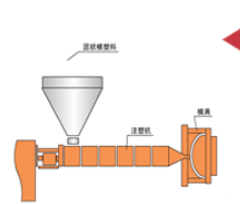
There are two steps in extrusion-injection process. Step one is “extrusion”: mixing the thermoplastic resin with glass fiber in an extruder, thus forming reinforced thermoplastic pellets. Step two is “injection”: converting the reinforced thermoplastic pellets into different parts using an injection molding machine. The advantages of the extrusion compounding process lie in its low cost conversion, due to high efficiency screw design, and versatile formulation possibilities.
Bulk Molding Compound (BMC)
Bulk Molding Compound (BMC) is a bulk pre-preg made by combining chopped glass strands, resin (typically polyester), filler, catalyst and other additives. The final mix and homogenization is made in different types of kneeders / mixers. BMC is compacted and packed in styrene tight bags in variable size, fitting all UP injection moulding machines stuffer units. BMC delivers excellent electrical resistance, good mechanical properties and outstanding heat and corrosion resistance. BMC is suitable for several processes, including Compression and Injection Molding. It is used in automotive, electrical & electronics, aerospace and defense applications

VIP Process
Vacuum Infusion process, also called Resin Infusion or Vacuum Bagging process, is a molding technique that uses vacuum to drive the resin into the laminate. Reinforcing materials, mats, pre-forms, fabrics, are laid into the mold and the vacuum is applied before the resin is introduced. The resin flows easily but slowly into the reinforcements. Permeability of the reinforcements is a critical factor which necessitates use of special molding mats in the core. This process is very complex to design and control; however, when properly executed it can produce high performance, large consolidated parts, such as Wind Blades or boat hulls.

RTM Process
Resin Transfer Molding (RTM) is a closed mold process which is used to make complex shapes. In this process, liquid resin is injected into a closed mold cavity which contains pre-placed reinforcement. The resin flows through the reinforcement, such as fiberglass mats, preforms or fabrics, impregnating and wetting it out. The composite material is cured under a low pressure and RT or moderate heat to form the final part.
FRP RAW Material
FRP Direct Roving,FRP Woven Roving,FRP Chopped strands,FRP Chopped Mat,Fiberglass Stitched Mat,Fiberglass Surfacing Veil.etc.

EXAMPLE OF HAND LAY-UP MOLD
Below are several examples of Hand Lay-up Mold which we have manufactured. Box, pump, drone, packing, cosmetics, etc.


Do not hesitate to send us 3D files for analyze of the ability to mold these parts. We are ready to listen and to assist you in your plastic injection molding project.


86-13143415646
Contact:
 Tel: 86-755-23000620 Fax: 86-755-23000621
 Email:info@galaxy3dm.com/info@seetoptech.com
 Address: A3 , Dingfeng Industrial Zone, Fuyong Town, Shenzhen, China
Galaxy 3D Manfacturing Solution
Copyright (©) 2020 Shenzhen Seetop Technology Co.,Limited
