


EOS 3D printing
SLSEOS 3D printing,Selective Laser Sintering (SLS)
Industrial SLS 3D printing
SLS
Selective Laser Sintering (SLS) is an Additive Manufacturing process that belongs to the Powder Bed Fusion family. In SLS, a laser selectively sinters the particles of a polymer powder, fusing them together and building a part layer-by-layer. The materials used in SLS are thermoplastic polymers that come in a granular form.
SLS 3D Printing is used for both prototyping of functional polymer components and for small production runs, as it offers a very high design freedom, high accuracy and produces parts with good and consistent mechanical properties, unlike FDM or SLA. The capabilities of the technology can be used to its fullest though, only when the designer takes into consideration its key benefits and limitations.
SLS can produce functional parts from a large range of engineering plastics, most commonly Nylon (PA12).
The typical build volume of an SLS system is 300 x 300 x 300 mm.
SLS parts exhibit good mechanical properties and isotropic behaviour. For components with special requirements, additive-filled PA powders are available.

Equipment
Galaxy3DM SLS 3D printing equipment includes EOS,TMP, FARSOON
| Materials | Thermoplastics (usually nylon) |
| Dimensional accuracy | ± 0.3% (lower limit of ± 0.3 mm) |
| Typical build size | 300 x 300 x 300 mm |
| Common layer thickness | 100 - 120 microns |
| Support | Not required |
Construction Volume: 500 x 330 x 400 mm (19.7 x 13 x 15.7 in)
Laser Type: CO₂, 2 x 70 W
Precision Optics : F-theta lens, surface module, high-speed scanner
Scan Speed: up to 2 x 10 m/sec (32.8 ft/s)
Power Supply : 400 V / 100 A; max. power consumption 80 A
Machine Dimensions (W x D x H):3,400 x 2,100 x 2,100 mm (133.9 x 82.7 x 82.7 in)
Recommended Installation Space : min. 7.2 x 5.2 x 4.2 m (284 x 205 x 165 in)
Weight : approx. 7,000 kg (15,432 lb)
Software: EOSYSTEM with EOSAME feature, EOSPRINT 2 with SmartScaling feature and EOS ParameterEditor, EOSCONNECT, EOSTATE Powderbed
Benefits & Limitations of SLS
The key advantages and disadvantages of the technology are summarised below:
SLS parts have good, isotropic mechanical properties, making them ideal for functional parts and prototypes.
SLS requires no support, so designs with complex geometries can be easily produced.
The manufacturing capabilities of SLS is excellent for small to medium batch production.
Only industrial SLS systems are currently widely available, so lead times are longer than other 3D printing technologies, such as FDM and SLA.
SLS parts have a grainy surface finish and internal porosity that may require post processing, if a smooth surface or watertightness are required.
Large flat surfaces and small holes cannot be printed accurately with SLS, as they are susceptible to warping and oversitnering.
Selective laser sintering (SLS) is an industrial 3D printing process that produces accurate prototypes and functional production parts in as fast as 1 day. Multiple nylon-based materials and a thermoplastic polyurethane (TPU) are available, which create highly durable final parts that require heat resistance, chemical resistance, flexibility, or dimensional stability. With SLS 3D printing, no support structures are required making it easy to nest multiple parts into a single build and an economical solution for when higher volumes of 3D-printed parts are required.
How Does SLS 3D Printing Work?
The SLS machine begins sintering each layer of part geometry into a heated bed of nylon-based powder. After each layer is fused, a roller moves across the bed to distribute the next layer of powder. The process is repeated layer by layer until the build is complete.
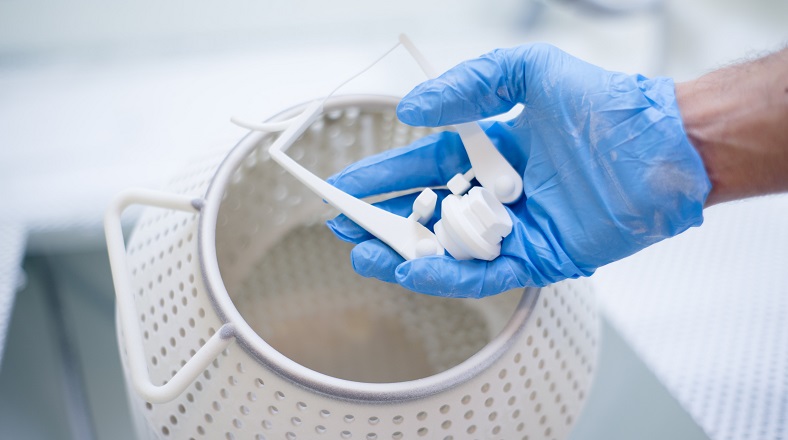
When the build finishes, the entire powder bed with the encapsulated parts is moved into a breakout station, where it is raised up, and parts are broken out of the bed. An initial brushing is manually administered to remove a majority of loose powder. Parts are then bead blasted to remove any of the remaining residual powder before ultimately reaching the finishing department.

Characteristics of SLS
Printer Parameters
In SLS almost all process parameters are preset by the machine manufacturer. The default layer height used is 100-120 microns.
A key advantage of SLS is that it needs no support structures. The unsintered powder provides the part with all the necessary support. For this reason, SLS can be used to create freeform geometries that are impossible to manufacture with any other method.
Taking advantage of the whole build volume is very important when printing with SLS, especially for small batch productions. A bin of a given height will take about the same time to print, independent of the number of parts it contains. This is because the re-coating step determines the total processing time (laser scanning occurs very rapidly) and the machine will have to cycle through the same number of layers. Bin packing may affect lead times of small orders, as operators usually wait until a bin is filled before starting a print.
Layer Adhesion
In SLS, the bond strength between the layers is excellent. This means that SLS printed parts have almost isotropic mechanical properties.
SLS parts have excellent tensile strength and modulus, comparable to the bulk material, but are more brittle (their elongation at break is much lower). This is due to the internal porosity of the final part.
A typical SLS printed part is about 30% porous.
Porosity gives SLS parts their characteristic grainy surface finish. It also means that SLS parts can absorb water, so they can be easily dyed in a hot bath to a large range of colors but also that they require special post-processing if they are to be used in a humid environment.
Shrinkage & Warping
SLS parts are susceptible to shrinkage and warping: as the newly sintered layer cools, its dimensions decrease and internal stresses buildup, pulling the underlying layer upwards
3 to 3.5% shrinkage is typical in SLS, but machine operators take this into account during the build preparation phase and adjust the size of the design accordingly.
Oversintering
Oversintering occurs when radiant heat fuses unsintered powder around a feature. This can result in loss of detail in small features, like slots and holes.
Oversintering depends both on the size of the feature and the wall thickness.
Powder Removal
Since SLS requires no support material, parts with hollow sections can be printed easily and accurately.
Hollow sections reduce the weight and cost of a part, as less material is used. Escape holes are needed to remove the unsintered powder from the inner sections of the component. It is recommended to added to your design at least 2 escape holes with a minimum 5 mm diameter.
Common SLS Materials
The most widely used SLS material is Polyamide 12 (PA 12), also known as Nylon 12. The price per kilogram of PA 12 powder is approximately $50 - $60. Other engineering thermoplastics, such as PA 11 and PEEK, are also available but are not as widely used.
Polyamide powder can be filled with various additives (such as carbon fibers, glass fibers or aluminum) to improve the mechanical and thermal behavior of the produced SLS part. Materials filled with additives are usually more brittle and can have highly anisotropic behavior.
Post Processing( Standard &Custom)
SLS parts produces parts with a powdery, grainy surface finish that can be easily stained. The appearance SLS printed parts can be improved to a very high standard using various post processing methods, such as media polishing, dyeing, spray painting and lacquering. Their functionality can also be enhanced by applying a watertight coating or a metal plating.
Galaxy3DM SLS 3D Printing Common SLS Materials
The most widely used SLS material is Polyamide 12 (PA 12), also known as Nylon 12.
Other engineering thermoplastics, such as PA 11 and PEEK, are also available but are not as widely used.
Polyamide powder can be filled with various additives (such as carbon fibers, glass fibers or aluminum) to improve the mechanical and thermal behavior of the produced SLS part. Materials filled with additives are usually more brittle and can have highly anisotropic behavior.
| Material | Characteristics |
| Polyamide 12 (PA 12) | Good mechanical properties |
| Good chemical resistance | |
| Matte, rough surface | |
| Polyamide 11 (PA 11) | Fully isotropic behaviour |
| High elasticity | |
| Aluminium-filled nylon (Alumide) | Metallic appearance |
| High stiffness | |
| Glass-filled nylon (PA-GF) | High stiffness |
| High wear & temperature resistance | |
| Anisotropic behaviour | |
| Carbon-fiber filled nylon (PA-FR) | Excellent stiffness |
| High weight-strength ratio | |
| Highly anisotropic |
Galaxy3DM SLS 3D printing Post Processing
Additional post process can be applied to improve the appearance or mechanical properties of parts produced with SLS.
Surface Finish and Post-Processing Options:
Standard:Bead blast to remove all powder, which leaves a consistent overall texture.
Secondary options: a primer or dye color that can be applied as well as taps and inserts.
Additional post processes can be applied to improve the appearance or mechanical properties of parts produced with SLS.

Available surface finishes for SLS 3D printing
1. As printed
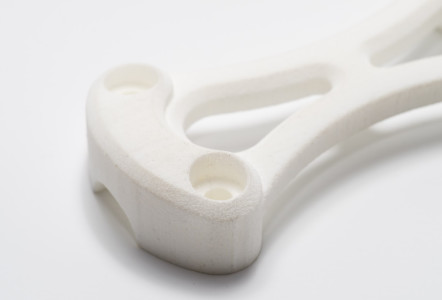
As printed SLS parts are typically white or stone grey in color with a smooth surface and a powder texture and without visible layers.
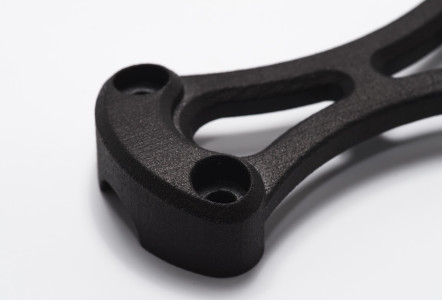
SLS parts can be dyed by immersing in a warm color bath to a variety of colors. The color penetration reaches an approximate depth of 0.5 mm and covers all surfaces.
3.Tumble smoothing:
The parts are placed in a tumbler that contains small ceramic chips, gradually eroding its surface down to a polished injection molding-like finish.
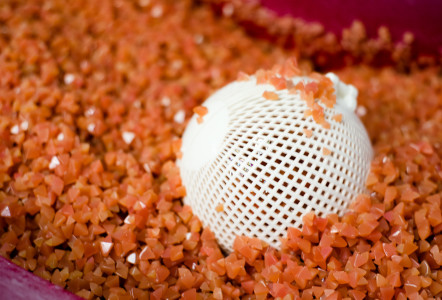
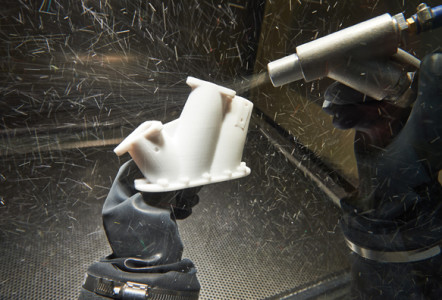
4. Bead blasting (shot pinning):
adds a uniform matte or satin surface finish on a 3D printed part.
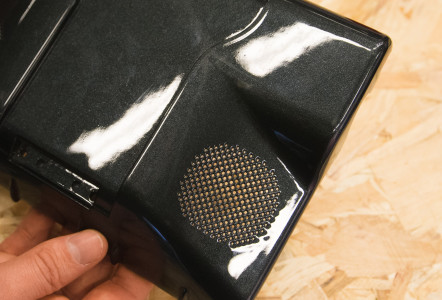
5.Spray painting :
SLS parts can be spray painted white, black or to a specified RAL or Pantone color.
6.Water tightening :
SLS parts are vacuum impregnated with resin, sealing all internal porosity and ensuring water tightness.
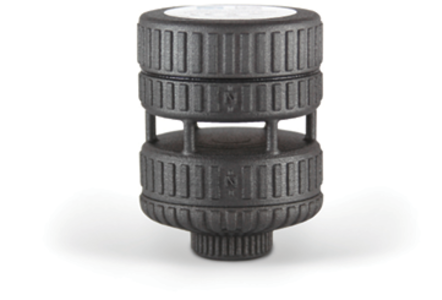
Electroplating (nickel, copper or gold) is an ideal solution for parts that require a metallic appearance, without the high costs associated with metal 3D printing.



 复制产品链接
 长按图片保存/分享
询盘
咨询表单:
咨询内容:
你还没有添加任何产品

询盘
咨询表单:
咨询内容:
你还没有添加任何产品


86-13143415646
Contact:
 Tel: 86-755-23000620 Fax: 86-755-23000621
 Email:info@galaxy3dm.com/info@seetoptech.com
 Address: A3 , Dingfeng Industrial Zone, Fuyong Town, Shenzhen, China
Galaxy 3D Manfacturing Solution
Copyright (©) 2020 Shenzhen Seetop Technology Co.,Limited
